How to Write a BIRP Note
Behavior. Intervention. Response. Plan. Here's a framework built for the realities of behavioral health documentation.
Clinical documentation isn't just an administrative requirement, but a clinical tool in its own right.
A well-written note captures what happened in session, why it mattered, and where treatment is headed next. Among the many documentation formats used across behavioral health settings, the BIRP note is one of the most widely adopted, particularly in community mental health, case management, and group therapy settings where a clear behavioral record matters as much as clinical impression.
A Brief History
BIRP notes emerged from behavioral health settings needing a documentation format that could capture both observable behavior and clinical response in a structured, defensible way.
Unlike SOAP notes, which originated in general medicine and emphasize a subjective/objective split, BIRP notes were built with behavioral and mental health treatment specifically in mind, placing behavior itself (rather than subjective complaints) as the starting point. Over the years, that structure has made BIRP a natural fit for settings where documenting observable client behavior, intervention specifics, and measurable response is central to funding, insurance, and treatment-planning requirements.
Breaking Down BIRP
B
BEHAVIOR
This section documents what the client presented with in session, both what they reported (statements, self-described symptoms, mood) and what the clinician directly observed (affect, body language, engagement level).
This is the clinician's objective and subjective snapshot of the client in the room.
I
INTERVENTION
This section records what the clinician actually did in session: the therapeutic technique, modality, or intervention applied, and the clinical reasoning behind that choice.
This is where the clinician's own professional action enters the note.
R
RESPONSE
This section captures how the client responded to the intervention in real time. Engagement, insight, resistance, emotional shifts, or behavioral change observed during the session itself.
This is distinct from long-term progress; it's a within-session measure of how the client received the intervention.
P
PLAN
This section documents what comes next: the plan for the following session, any changes to the treatment plan, homework or between-session tasks assigned, and follow-up needed.
This keeps each note connected to the broader arc of treatment.
Our Tips for Writing Strong BIRP Notes
- Keep behavior observable and specific.
- Rather than "client was anxious," document what anxiety looked like: "client's speech was rapid, and they reported difficulty sleeping over the past week."
- Tie the intervention to clinical reasoning.
- Naming the technique used (e.g., "used cognitive restructuring to challenge client's catastrophic thinking") is more defensible than a vague description of "talked through the issue."
- Distinguish response from progress.
- Response is about the session itself, not the client's overall trajectory, so save broader progress notes for treatment plan reviews.
- Make the plan actionable.
- A strong plan section names a specific next step, not just "continue treatment."
A Potential Before and After
Before BIRP: |
After BIRP: |
| Client seemed upset today. We talked about their week. Client agreed to keep working on things. Will see them again next week. |
B: Client presented with flat affect and reported feeling "overwhelmed" by ongoing conflict with a family member. Client described difficulty concentrating at work over the past week. |
| I: Clinician used motivational interviewing techniques to explore client's ambivalence about setting a boundary with the family member. |
|
| R: Client identified two potential boundary-setting statements and expressed cautious willingness to try one before the next session. |
|
| P: Client will practice the identified boundary statement and report back on outcome at next session, scheduled for [date of next session]. |
Notice what changed between the two versions above.
The "before" note tells us a session happened; the "after" note tells us what actually took place within it (what the client presented with, what the clinician did in response, how the client engaged with that intervention, and what comes next). That's the real value of the BIRP format: it doesn't just document that treatment occurred, but captures the clinical reasoning behind it, session by session.
Over time, notes like this build a record that supports better continuity of care, stronger clinical decision-making, and documentation that holds up under review. ◼
Free Download: Impact CE's BIRP Note Template
A practical template (with examples) designed for therapists and licensed practitioners across disciplines.
Available below and ready to print or fill out digitally.
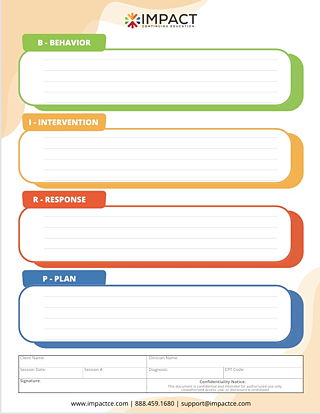
BIRP Note Template (Free Download)
Want to make the most of everything Impact CE has to offer?
The Ignite Membership unlocks Premium events and Masterclasses, Unlimited Live Webinars, Hundreds of Self-Paced Courses, a Growing Library of Recorded Content, and Free E-Library access — all in one place, for one low annual price. Learn more about Ignite today.