What Are SMART Goals?
A Therapist's Guide to Writing Goals That Actually Work
If you have ever written a treatment goal that felt vague, unmeasurable, or difficult to track (or if you have worked with a client who struggled to connect their goals to their actual progress) you are not alone.
Goal-setting is one of the most foundational skills in clinical practice, and yet it is also one of the areas where even experienced practitioners find themselves relying on habit rather than intention.
The SMART goal framework offers a structured, reliable approach to writing goals that are not just well-intentioned, but genuinely clinically useful. So, whether you work in behavioral health, physical therapy, occupational therapy, social work, or any other helping profession, SMART goals provide a common language for setting expectations, tracking progress, and keeping treatment focused and accountable.
A Brief History of S.M.A.R.T. Goals
The SMART framework was first introduced in 1981 by George T. Doran, a consultant and former Director of Corporate Planning for Washington Water Power Company, in a management journal article titled "There's a S.M.A.R.T. Way to Write Management's Goals and Objectives." Doran developed the acronym as a practical tool for helping organizations write objectives that were clear enough to act on and evaluate (a problem that, as any clinician who has reviewed a vague treatment plan knows, is not unique to the business world).
Over the following decades, the SMART framework was adopted and adapted across healthcare, education, psychology, and coaching. Today it is embedded in clinical training programs, treatment planning protocols, accreditation standards, and insurance documentation requirements across virtually every helping profession. Its durability comes from five simple criteria that, when applied consistently, transform a wish into a workable plan.
What Does SMART Stand For?
SMART is an acronym, with each letter representing one of the five criteria that define a well-written clinical goal. Together, they ensure that every goal is concrete enough to pursue, clear enough to measure, and realistic enough to achieve.
S
SPECIFIC
A specific goal clearly identifies what the client will do, in what context, and with what support if needed. It answers the question: what exactly are we working toward? Vague goals like "improve communication" become specific goals like "client will use one grounding technique when feeling overwhelmed in social situations.
M
MEASURABLE
A measurable goal includes a way to track progress and determine when the goal has been achieved. This might be a frequency ("three times per week"), a rating scale score, a distance walked, or a number of sessions completed. Without measurability, progress becomes a matter of opinion rather than evidence.
A
ACHIEVABLE
An achievable goal is realistic given the client's current level of functioning, resources, and circumstances. It is ambitious enough to represent meaningful progress, but grounded enough that the client can realistically reach it within the treatment timeframe. Goals that are too easy produce little motivation; goals that are too lofty set clients up to feel like they have failed.
R
RELEVANT
A relevant goal is directly connected to the client's presenting concerns, values, and overall treatment plan. It should matter to the client, not just to the clinician or the documentation requirements. When clients can see how a goal connects to what they actually want for their lives, motivation and follow-through increase significantly.
T
Time-Bound
A time-bound goal includes a clear target date or timeframe for achievement. This creates accountability, helps clinicians assess whether treatment is progressing as expected, and gives clients a concrete horizon to work toward. Without a timeframe, goals can drift indefinitely without ever being evaluated or updated.
Putting It Into Practice
To see the difference the SMART framework makes, compare these two versions of the same goal:
- Non-SMART version: "Client will work on managing anxiety."
- SMART version: "Client will independently apply a diaphragmatic breathing technique for five minutes at least four times per week when experiencing anxiety symptoms, as reported in session, within the next 30 days."
The SMART version tells everyone involved (the client, the clinician, the treatment team, and the payer) exactly what success looks like and when to expect it. It is specific enough to guide the work, measurable enough to track, achievable within the timeframe, relevant to the presenting concern, and time-bound so progress can be evaluated.
3 Tips for Writing Effective SMART Goals With Clients
- Whenever possible, involve clients in the goal-setting process: ask them what they want to be able to do differently, how they will know when things are better, and what a realistic first step looks like. Client-generated goals are far more likely to be pursued with genuine investment.
- Write goals in plain language the client can understand and connect with instead of clinical shorthand.
- Review and update goals regularly as treatment progresses, and be sure to note session to session progress.
Use Our Free SMART Goals Template
To make goal-setting as clear and consistent as possible across your caseload, the Impact CE team has put together a free, ready-to-use SMART Goals template designed for therapists and licensed practitioners across disciplines. Download it below and make it your own.
Free Download: Impact CE SMART Goals Template
A practical template (with examples) designed for therapists and licensed practitioners across disciplines.
Available below and ready to print or fill out digitally.
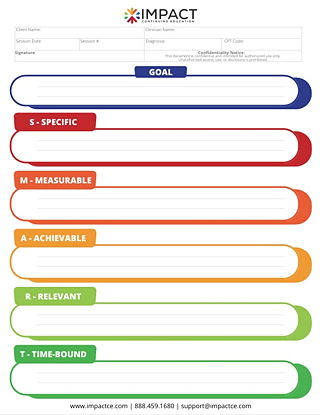
SMART Goals (Free Template)
Want to make the most of everything Impact CE has to offer?
The Ignite Membership unlocks unlimited live webinars, hundreds of self-paced courses, a growing library of recorded content, and free e-library access — all in one place, for one low annual price. Learn more about Ignite today.