When the Body Loses Its Edge
A Somatic Look at Boundary Rupture

"A client who cannot hold a boundary is not failing at a skill. Their nervous system is failing to register the threat that a boundary violation represents, or it registered that threat at some point and learned that responding to it was more dangerous than absorbing it."
104599 Where You End and I Begin: A Somatic Intensive for Boundary Restoration
This advanced interactive training offers an in-depth somatic framework for understanding boundary rupture and restoration through the lens of the autonomic nervous system. Drawing from Somatic Experiencing and polyvagal theory, participants will examine nuanced clinical presentations where boundary collapse is common, deepen their understanding of embodied defense responses, engage in experiential boundary mapping and regulation practices, and develop more advanced...
I have sat with a lot of clients over the years who came in saying some version of the same thing: "I know I need better boundaries. I've read the books. I know what to say. I just can't seem to do it."
And for a long time, early in my career, I gave them more of what hadn't worked. More cognitive tools. More scripts. More rehearsed language. We'd work on assertiveness. We'd practice the hard conversations. And sometimes it helped a little, and sometimes it didn't help at all, and I couldn't always tell you why.
What I understand now, fifteen years and a Somatic Experiencing training later, is that I was working at the wrong level. Boundary difficulties in trauma survivors are not primarily a knowledge problem or a skill problem.
They are a nervous system problem.
And until we get into the body, we are mostly working around the actual issue rather than through it.
That's the premise behind my upcoming training, "Where You End and I Begin: A Somatic Approach to Boundary Restoration," and I want to use this article to offer some of the foundational thinking that will shape our time together.
Boundaries Are Neurobiological Events
When we teach clients about boundaries in traditional clinical training, we tend to frame them as relational agreements or communication skills. And they are those things, partly. But that framing misses something more fundamental about what a boundary actually is.
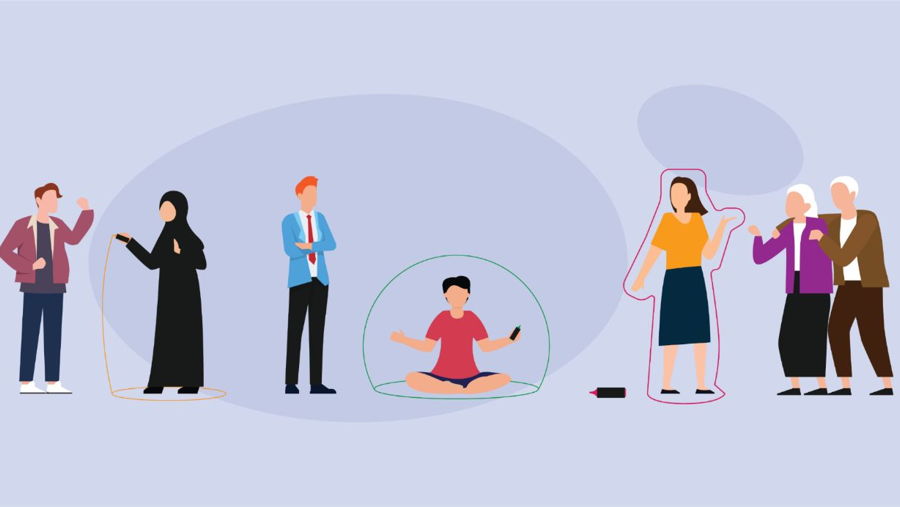
In the Somatic Experiencing model, rooted in the work of Dr. Peter Levine, we talk about the kinesphere, which is the three-dimensional bubble of peri-personal space that surrounds each of us. Think of it less like a fence and more like a cell membrane: selectively permeable when healthy, allowing some things in and some things out, based on an ongoing, mostly unconscious process of threat assessment.
Bob Scaer, a neurologist and trauma researcher whose work has deeply influenced somatic practice, describes it this way in The Body Bears the Burden (Scaer, 2014): all of our senses contribute to the formation of boundaries that tell us where we as a perceptual whole, and the rest of the world, begin. This boundary awareness is not cognitive. It is happening at the level of the nervous system, below conscious thought, in the same subcortical regions that manage threat detection, defensive responses, and survival.
What that means clinically is this: a client who cannot hold a boundary is not failing at a skill. Their nervous system is failing to register the threat that a boundary violation represents, or it registered that threat at some point and learned that responding to it was more dangerous than absorbing it.
Boundary Rupture as a Trauma Symptom
One of the most clarifying things I learned in my SE training is that ruptured boundaries are a universal symptom of shock trauma. Not a personality trait or a character flaw.
When the nervous system has been repeatedly overwhelmed, the kinesphere takes the hit in specific ways. Clients describe it in vivid terms, even when they don't have language for the neuroscience behind it. They say things like, "I feel like I have no skin." Or, "I can feel what everyone around me is feeling and I can't turn it off." Or, they go the other direction and say, "I don't even notice when someone is too close until it's way too late."
These presentations reflect different nervous system states and different patterns of boundary disruption. A client in a sympathetic fight/flight state often has a reactive, hypervigilant boundary, one that fires too easily in some directions and not at all in others. A client in dorsal vagal shutdown often has a boundary that has essentially gone absent, collapsed along with the rest of their defensive responses. And a client living in the fawn response, which is what we tend to see in people with chronic relational trauma, has often learned to suppress the boundary impulse entirely, sometimes before it ever reaches consciousness.
And here’s the reality: the body says "no" a fraction of a second before the mind registers the threat. In a regulated nervous system, that signal gets through. In a traumatized nervous system, it gets intercepted.
What This Looks Like in Clinical Practice
When I sit with a client who struggles with boundaries, I am now tracking a different set of questions than I used to ask. I am watching for where the body contracts and where it goes still. I am noticing whether they orient toward me or away from me when they talk about certain relationships. I am curious about the subtle postural shifts that happen when they describe a situation where a boundary was crossed.
Those signals are not random. They are the nervous system communicating exactly where the rupture happened and what it needed to do and couldn't. And they are the starting point for restoration.
In SE, we talk about working the edge, starting from where the boundaries are still intact and building outward from strength rather than pushing into the rupture directly. This matters enormously in clinical practice. Clients who have experienced chronic boundary violations need to spend time in contact with what does feel solid and safe before they can tolerate working with what doesn't. Rushing to the rupture, even with good intentions, can replicate the original injury.
The embodied practices I use in this work, and that we will practice together in the training, are designed around this principle. We start with the literal physical boundary of the skin, asking the client to bring attention to where their body ends and space begins. That may sound simple, but for many trauma survivors, it is genuinely novel. Then we expand outward into the kinesphere, using slow movement to define and feel the edges of personal space. And then we bring another person into proximity and practice tracking the nervous system's response in real time.
So, yeah, this is not talk therapy with some breathing exercises added in. It is a different way of working entirely.

104642 Emotional Literacy for Professionals
Emotional Literacy for Professionals is a 90-minute training designed for social service, behavioral health, mental health, child welfare, education, and community-based professionals who regularly work in emotionally demanding environments. Professionals in these fields often absorb stress from crisis work, trauma exposure, client pain, systemic barriers, workplace pressure, and community grief. Over time, this emotional load can affect communication, decision-making, empathy,...
Why Practitioners Need This Too
I would be leaving something important out if I didn't name that boundary work in the clinical setting is not just about the client. It is about us too.
Polyvagal theory, developed by Dr. Stephen Porges, gives us the concept of co-regulation, the way our nervous systems are in constant implicit communication with each other. When we are with a client, our own nervous system state is a clinical instrument. A regulated practitioner provides a physiological signal of safety that the client's subcortical brain can actually receive. A dysregulated practitioner, one who has merged rather than joined with the client's experience, one who has lost their own edge in the room, is not able to offer that signal.
This is one of the reasons I end every training I do with a section on the practitioner's nervous system. I don’t see it as a self-care add-on, but rather a clinical competency.
What We Will Cover
The training is structured in three main sections. The first establishes the neurobiological foundation, including how each polyvagal state produces a distinct pattern of boundary disruption and why that matters for how we assess what we are seeing in session. The second section examines three specific clinical populations in depth: clients who present with fawn responses and people-pleasing patterns, clients whose histories involve enmeshment or codependency, and clients with dissociative shutdown. Each population has a distinct somatic signature, and recognizing those signatures changes how we work. The third section is experiential, and it is where the real learning happens.
My hope for this training is that practitioners leave with a felt sense of this work, not just an intellectual understanding of it. The nervous system does not change through information alone. It changes through experience. So we will practice.
I have been doing this work with clients for a long time, and I am still moved by what happens when someone finds the edge of their own space for the first time. There is something that settles in the room, and the body gets to takes a breath it didn't know it was holding. ◼
104599 Where You End and I Begin: A Somatic Intensive for Boundary Restoration
This advanced interactive training offers an in-depth somatic framework for understanding boundary rupture and restoration through the lens of the autonomic nervous system. Drawing from Somatic Experiencing and polyvagal theory, participants will examine nuanced clinical presentations where boundary collapse is common, deepen their understanding of embodied defense responses, engage in experiential boundary mapping and regulation practices, and develop more advanced...
Want to make the most of everything Impact CE has to offer?
The Ignite Membership unlocks unlimited live webinars, hundreds of self-paced courses, a growing library of recorded content, and free e-library access — all in one place, for one low annual price. Learn more about Ignite today.
Reference:
Scaer, R. (2014). The body bears the burden: Trauma, dissociation, and disease (3rd ed.). Routledge.
Opinions and viewpoints expressed in this article are the author's, and do not necessarily reflect those of CE Learning Systems.